The Orangutans of Borneo
My visit to Camp Leakey, October and November 2004
The photos and brief stories below tell a few of my experiences from the six week Orangutan Foundation Volunteer Program www.orangutan.org.uk (link opens in new window). It is hard to express in words or photos the magic of the National Park - experience it for yourself by volunteering next year! There are 3 to 4 groups per year with 12 places available per group. The cost is £500 which pays for all your food, accommodation, park fees, other expenses with some money left-over to fund the projects you will be involved in. It was the most rewarding and fascinating trip of my life.
Thanks to Barbara and Elke whose photos I have used as well as my own. Click on the photos for larger images.
 The Journey to Camp

Visiting Camp Leakey is not a straightforward affair. My journey from London Heathrow took 6 days including 4 flights, one 12-hour bus journey a number of taxi rides and finally the 4 hour klotok (boat) trip up the Sekonyer River.
 Camp Leakey is located in Tanjung Puting National Park in the province of Central Kalimantan. Kalimantan is the name of the part of Borneo that is owned by Indonesia. The rest of Borneo is either owned by Malaysia or the small oil-rich country of Brunei. My chosen route to Camp Leakey took me by aeroplane briefly through Kuala Lumpur and over the South China Sea to Kuching in Malaysian Borneo (look in the North-West of the map). I spent one day and two nights eating fantastic Malaysian seafood and relaxing in this easy going city.
 The photo shows fellow travellers Job (Dutch) and Turk (American) while we were eating in one of the roof-top seafood restaurants.
The 12-hour bus journey from Kuching was actually quite pleasant thanks to the Executive bus with wide and fully reclining seats. We drove through vast palm oil plantations (link opens in new window) in Malaysian Borneo (the palm oil 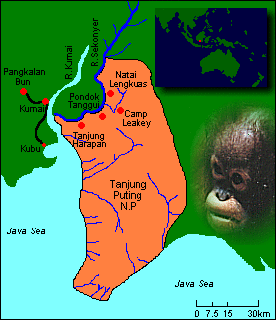 industry is one of the greatest threats to the rainforest which is cut down and replaced with this highly productive oil source) and then through immigration and into Kalimantan.
After 9 bumpy hours (the Indonesian roads were poor compared to those of Malaysia) we arrived in Pontianak where I found a helpful local chap who showed me to a cheap hotel, an ATM (stock up on cash while you can as ATMs are hard to come by and often don't work) and a superb Malaysian restaurant serving fresh seafood and vegetables fried in a giant wok.
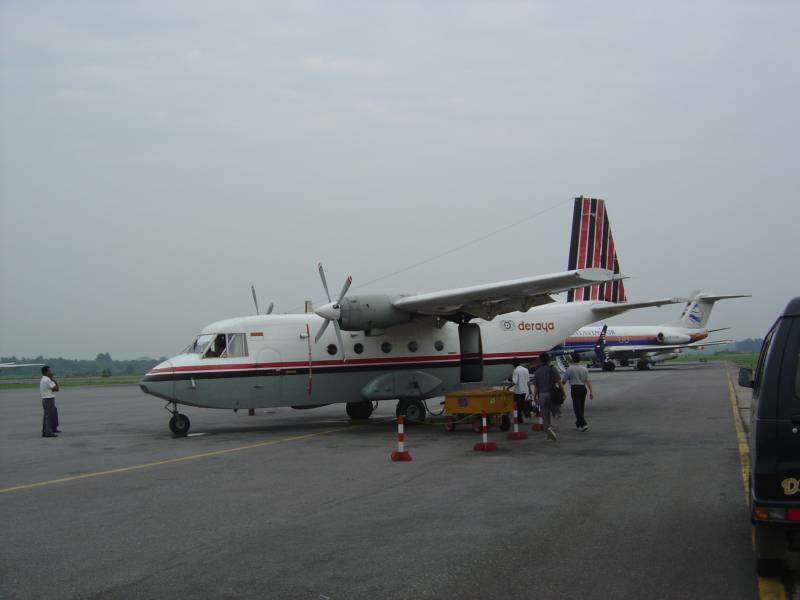 The two flights from Pontianak to Pangkalan Bun took about 4 hours and I was mightily relieved when we reached our destination. The 17 seater twin propeller aircraft was rickety to say the least and looking through into cockpit (there was no door) I wondered how many of the buttons the pilots actually knew how to use.
Elke and John, the coordinators of the Volunteer Program, greeted me at the airport and also fellow volunteer Brent who arrived on a separate flight - fortunate timing as the tiny airport only receives a handful of flights per day.
 We met the other volunteers later that day and were briefed on what to expect over the next 6 weeks. We had a beer or two that night although alcohol was outlawed a few years ago by the local Bhupati after some local violence. From left to right in the photo: Brent, Pip, Franca, Rob, Elke, Cheryl, John, Rebecca, Jake, Roy, Marion, Sam, Bill, Barbara, Cynthia.
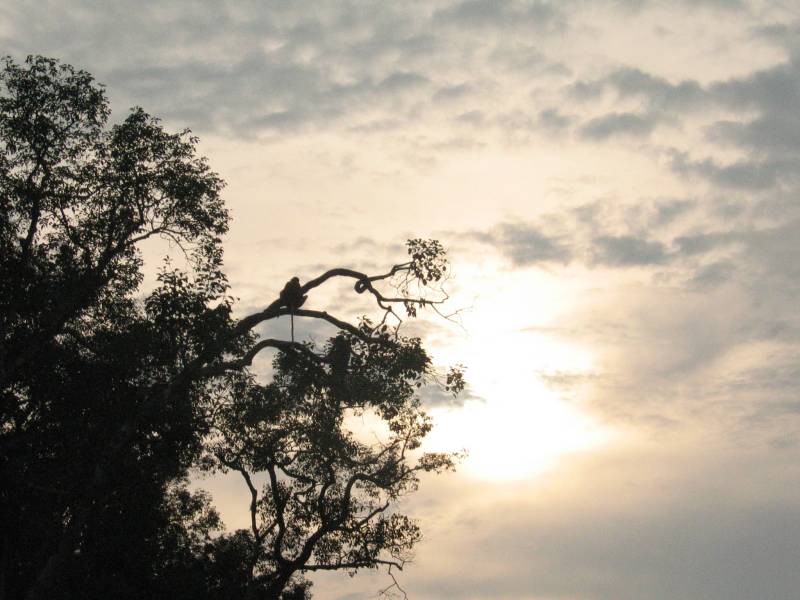 The extensive river system remains the only route into much of the forest of Borneo. After a bumpy taxi ride, we boarded the klotok that would take us to camp. As the boat chugged up the river we spotted crocodiles, birds of paradise and then at sunset we watched platoons of proboscis monkeys and gibbons as they nested for the night overlooking the river.
 We arrived at Camp Leakey at night and were relieved when we entered the team house where we would sleep for much of the coming 6 weeks. With a roof, walls and orangutan-proof door locks (mischievous orangutans try to break-in searching for food or just for fun) it was more comfortable than 6 weeks in a hammock that I had been readying myself for.
 Meeting the orangutans

The next couple of days were rest days as we acclimatised to the 95%+ humidity and 30+ degree heat. You sweat just sitting still in these conditions.
One afternoon we went to the feeding station to watch orangutans come for free bananas. 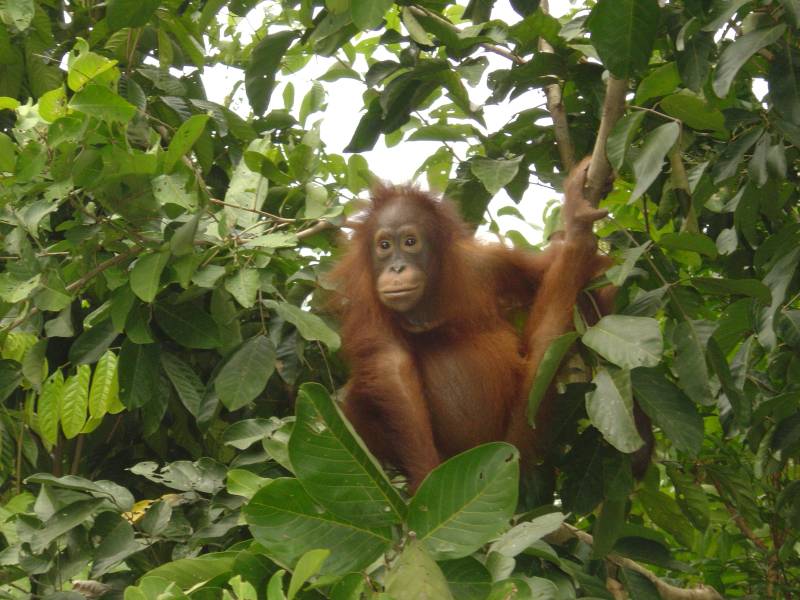 Daily feedings have been given for many years now because ex-captive orangutans have been released into the study area around Camp Leakey. These orangutans may have been illegally kept as pets or may have been driven into contact with humans due to logging or farming. As soon as the Orangutan Foundation becomes aware of such an orangutan, it is retrieved and taken to the Orangutan Care Centre where it is rehabilitated (often they are infants and need caring for until they are 7-8 years old). When it is deemed capable of surviving alone, the orangutan is returned to the wild.
 Hundreds of orangutans have been released into the study area over the past decades (Biruté Galdikas and Rod Brindamour first arrived here and founded Camp Leakey in November 1971 and soon began confiscating those kept as pets). Because the area already had a healthy wild orangutan population, competition for food increased so daily feedings are provided for orangutans needing extra nutrition.
 If the forest is very productive, no orangutans may come to the feeding, if it is less productive, many can come. We saw up to 10 orangutans in any one day at the feeding station. The infant orangutan (about 8 years old) in the photo above is using the banana clump as a stool.
The more human contact orangutans have had (usually during rehabilitation),  the more likely they are to return to camp to visit the people living there. Walking around Camp Leakey, you are almost guaranteed to see orangutans somewhere. Either near the kitchen/dining room and typing house (where research notes are typed up) or longhouses where the assistants live or down one of the two long jetty's which lead to the river.
It is difficult to see a wild orangutan in their natural habitat - it usually takes several days of searching in the forest canopy. If you do find one, it will probably be 50+ feet up in the trees so there is no opportunity to see them close up.  These are a couple of the reasons why they were not studied with great success until Dr Galdikas came to Borneo and also why they have received less media coverage than the two well-documented great apes - chimpanzees and gorillas.
The orangutans that visit camp walk along the ground and sometimes sit in small groups. We saw a group of four orangutans sitting together but this is rare. Orangutans believe in quality of time, not quantity!
Siswi is the most mature of the female orangutans that like to live in or around camp.  She enjoys human contact and may sit with you and hold your hand.
In the photos to the right, she came across Barbara on the jetty and took a liking to her sarong. After unraveling it from her, Siswi wrapped herself up in it and rolled around!
 The Care Centre

The Orangutan Foundation Care Centre is located near Pasir Panjang, the village in which most of the assistants families live. About 180 orangutans were in the Care Centre when we visited. The majority are infants (0-4 years) or juveniles (4-7 years) who are adopted by assistants (about 100 assistants work at the care centre). More orangutan facts here (link opens in new window).
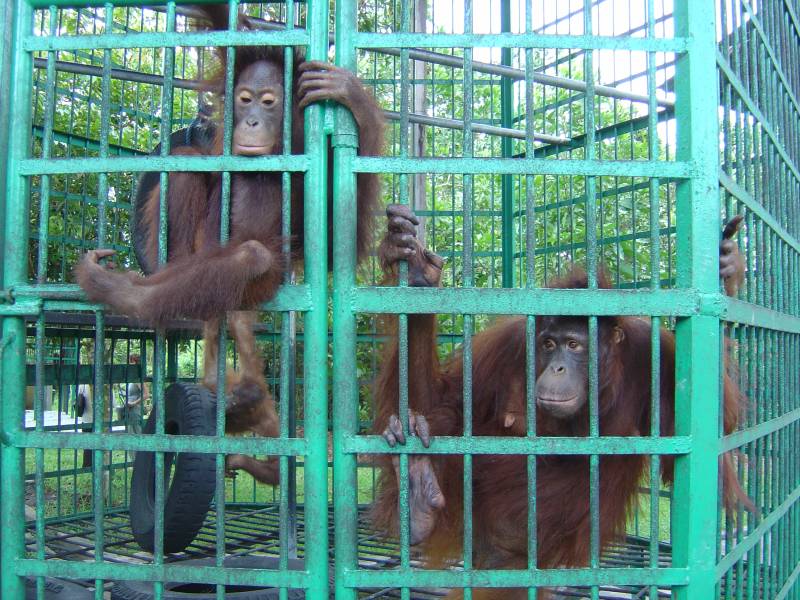 The assistants act as surrogate mothers, taking the orangutans to the forest each day so they can climb in the forest and eat fruits from real trees. Sometimes they do not want to come down again so the assistants need to climb up the trees to retrieve them! Sepon showed me how to climb a tree, going straight up the trunk. He made it look easy... I did manage to get up, just, but I almost broke my leg trying to get down!
 One of the orangutans, Kiki, had recently contracted an unknown disease which paralysed her. She seems to be recovering slowly and now has movement in her head and some in her arm. She is pictured to the right.
During the time we were in Borneo, the Professor returned briefly from UCLA to release about 20 of the rehabilitated orangutans back into the forest at a new release site, Lamandau Reserve. They join hundreds of other orangutans that have been rehabilitated by the Orangutan Foundation and released to the forest to live a normal life.
The work we did
Had there been more rain, our main project for the 6 weeks would have been building a guardpost at a new location in the forest but the rivers were not high enough to transport the building materials upstream.
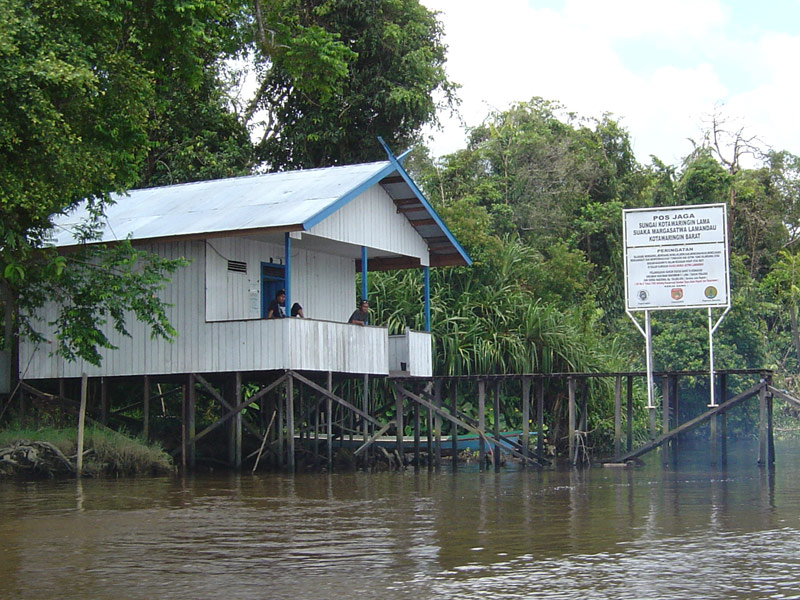 Guardpost's typically have two rooms, a simple toilet and a deck outside. They are located in strategic positions around the Park (often on rivers) so that they can be manned night and day by Orangutan Foundation staff (usually local Dayak people) who track activity on the river and go on patrols into the forest listening for chainsaws. If I remember correctly, there are 17 guardpost's around the Park and more are built when conditions allow. They have been successful in catching illegal loggers and send a clear message to would-be loggers that they are being watched.
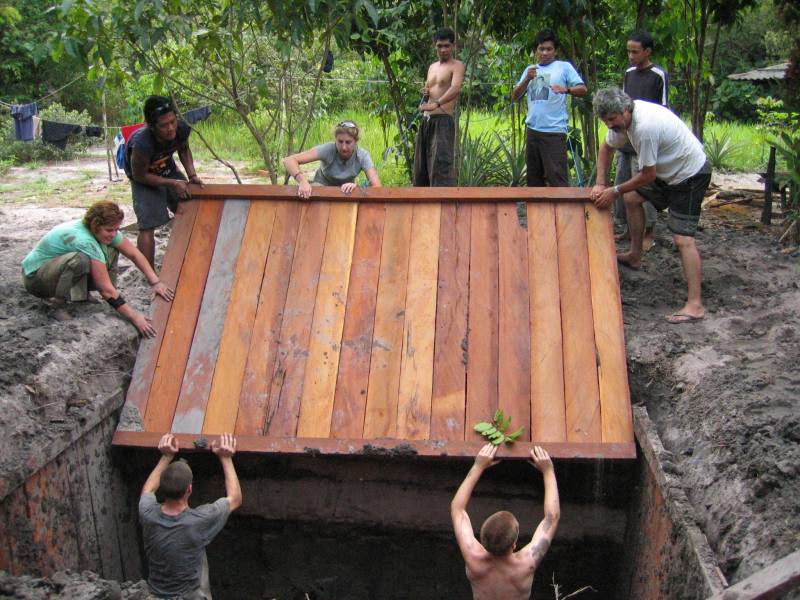
 Over the 6 weeks, we worked on a number of smaller projects. Most days there were a number of things going on - sawing, chiseling, nailing, painting, repairing orangutan-damaged buildings, replacing old planks with new on the jetty.
Our largest project was to build a toilet and mandi (wash) room at the guardpost by Tanjung Harapan. This is quite a large guardpost and previously the toilet was shared with another NGO.
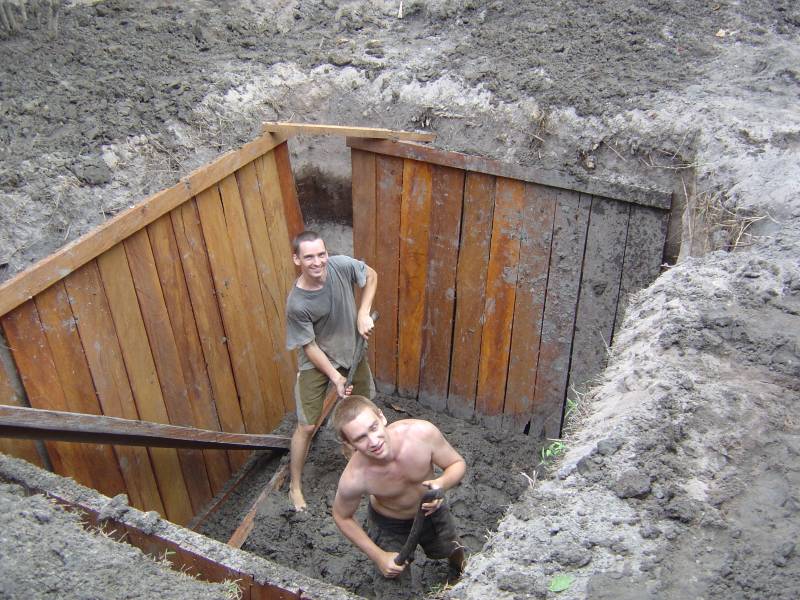 Constructing the toilet building and water tower was fairly straightforward but digging a hole 2.3 metres deep and 3m x 2m square was a different matter! A JCB digger would have done it in an hour but we had just two shovels. It took about 10 days. We calculated that under normal use by four people per day, the hole would take 82 years to fill.
 Most of the assistants employed by the Orangutan Foundation are Dayak (link opens in new window). The Dayak are the indigenous people of Borneo and have an incredible knowledge and understanding of the forest.
The guys (they are all male except the cooks) are all totally committed to helping the forest and the orangutans.  They live in camp for many weeks at a time, away from their families and earning a meager salary. But they love their jobs and they would much rather be living in the forest, helping the orangutans than in a city. I really felt honoured to be around them. The photo to the right is of Sepon with whom we worked every day.
Destruction of the forest
 We took a day off to get a closer look at the ongoing destruction of the rainforest. Our speedboat journey up the river on which Pangkalan Bun is situated took us past the great sawmills and loading bays where thousands of tree trunks were loaded onto giant steel barges ready for transportation around the world. When you see the scale of the logging operations behind the deforestation you wonder how you can reverse it.
 The logging here is legal. At least illegal loggers can be kicked out of the National Park but here, logging concessions have been sold to forestry companies and they are not holding back.
There does not appear to be long term forestry planning - no effort at logging the forest in a sustainable way. It made me feel sick inside and angry that this is allowed to go on. Have we not yet gained enough experience in forestry to be able to take from the forest without destroying it? 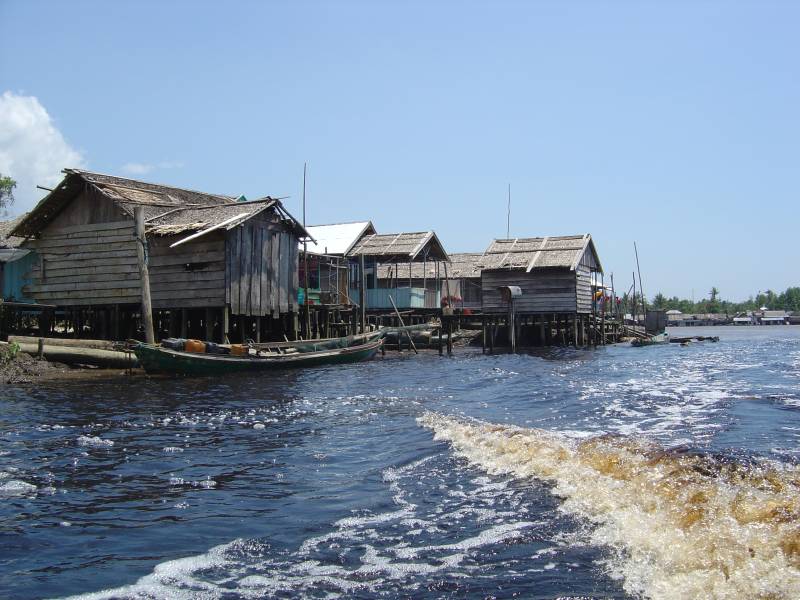 If we do have this experience, why are the companies which have concessions to log what remains of the forest not encouraged to practice such techniques? Surely we must have highly trained and experienced forestry professionals in the West that could help Indonesian logging companies develop sustainable forestry programs that do not totally destroy the forest and the plants, insects and animals which depend upon it.
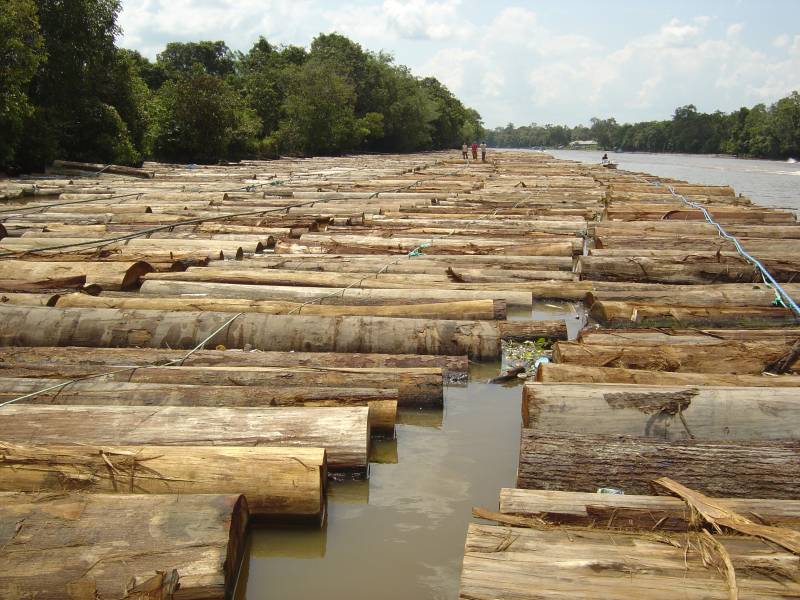 Large scale exploitation of the forest began in the 1960's. In 1967, all Indonesian forests were declared property of the state and it has since been selling off concessions to companies allowing them to log the forest. In 1991, 60% of the Borneo land surface was still natural forest. In 2001, this had fallen to an estimated 45% and today may be as low as 35% (information from OFI).
 The Malaysian part of Borneo has been just as savaged as the larger Indonesian section - 90% of the forest in Sarawak is under logging concession. Less than 10% of the total forest of Borneo is formerly protected. (Most of these statistics are taken from Rijksen and Meijaard, 2001).
Once an area has been logged, it is vulnerable to palm-oil plantation, agriculture, settlement or mining. One day we took a klotok upriver to visit the Aspai goldmine. Mining has taken place here for many years (after a mining concession was granted)  and has contributed to the Sekonyer turning from its natural dark colour (due to filtration through the peat bog on which this area of forest lies) to a milky tea colour. The photo shows the clear contrast where a clean tributary from the national park meets the main Sekonyer river.
Chechep, a University student from Java, received his first set of results back from laboratory analysis which confirmed the 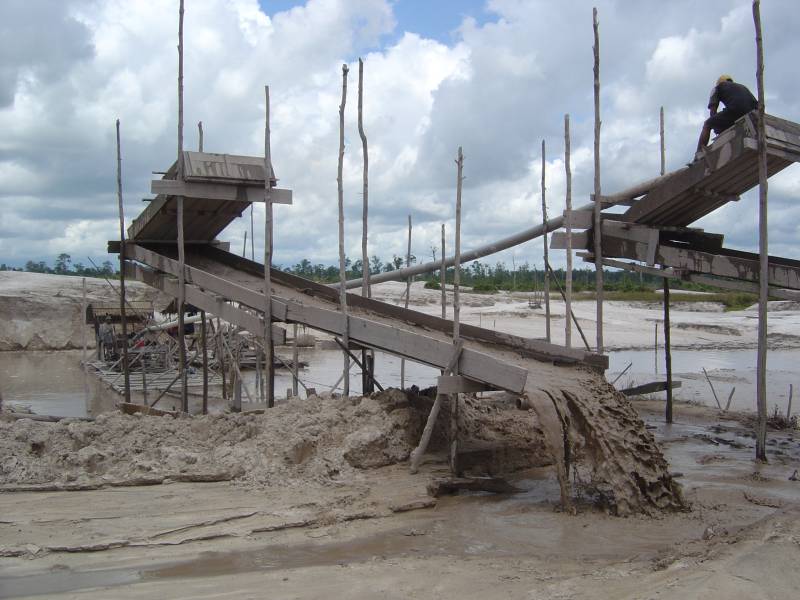 amount of sediment carried in the river is far in excess of limits set by the authorities. Hopefully this will make a strong case against the activities of the mine and it will be forced to clean up the operation. But things don't operate here as they do in the West.
When we arrived at the goldmine we saw a new landscape. It reminded me of Fraser Island - the worlds largest sandy island off the east coast of Australia.  As you can see from the photos, there is very little vegetation and no soil remains - only sand. It is difficult to imagine that this was once lush tropical rainforest supporting thousands of species of plants and animals. Will anything ever grow here again? Given some help and a few centuries, I assume it is possible. Will it ever return to its original form? I don't think so - this land is too far gone.
A new President
There is hope that the new president of Indonesia, Susilo Bambang Yudhoyono, will follow through on his promise that:
The government will get serious about dealing with these crimes [illegal logging], which have led to the rapid destruction of our forests. Illegal loggers and timber smugglers are causing the nation to suffer great losses. (11/11/04)
 On 'The day we nearly met the President' he flew to Borneo with the aim of seeing for himself the destruction caused by illegal logging. In typical fashion, nobody knew whether or not he would actually land at Camp Leakey as planned but the military and police came to Camp in readiness. We all put on our best clothes (trousers and a clean t-shirt) and a helipad was prepared for him to land.
 In the event, he flew overhead escorted by two other helicopters, inspecting the park from the air. The key thing is he is showing more interest in conservation than his predecessors - we believe he may have been only the second president ever to visit Borneo! This article is worth a read (opens in new window).
Following a wild orangutan
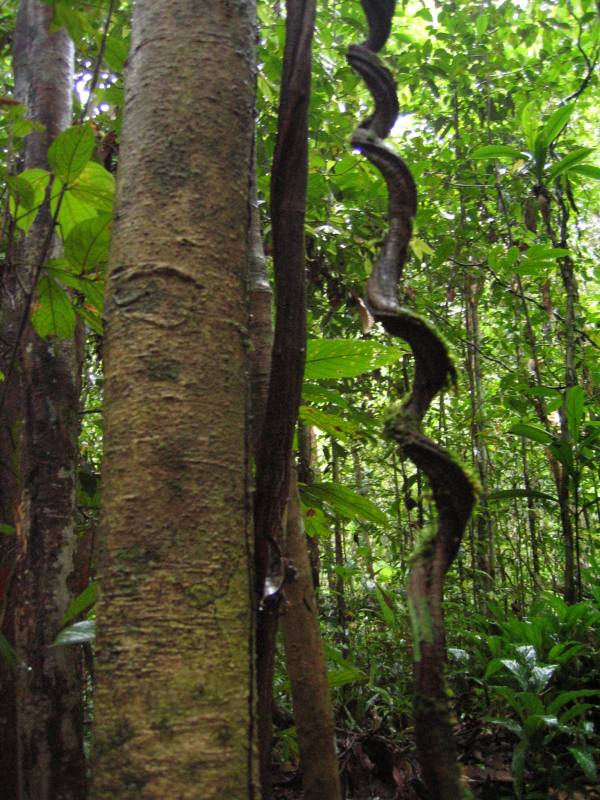 All volunteers have the opportunity to join two of the camp researchers who go into the forest every day to track wild orangutans (i.e. those orangutans that were not rehabilitated ex-captive orangutans). Tracking and then following wild orangutans to find out about the behaviour of these great apes was the foundation of Biruté Galdikas' research which started when she first arrived in November 1971 and still continues to this day. It continues today in much the same way and is an amazing experience especially being guided by such experts as Sebri and Herman - there is little about the forest that the guys do not know.
 Barbara and I woke at 4am and trekked into the forest guided by Sebri and Herman. The guys had been searching for three days and finally had success the day before when they came across Michelle and followed her until she nested (orangutans build nests by bending trees together and making a stable platform on which to sleep).
Michelle is one of the adult females whose range (female orangutans live their lives in the same range, adult male orangutans live in ranges but move to new ranges every few years) is within the study area (this is the same area that has been studied since 1971). We walked for about an hour and a half to the location where Michelle had nested with her as yet unnamed infant (Dr Galdikas or 'The Professor' as she is known names all the orangutans).
 We arrived at the location by walking down some of the tracks through the study area and then off the track to Michelle's specific location. We strung-up our hammocks and waited for mother and daughter to awaken.
As dawn broke, we heard rustling and shortly after, the two slowly moved out of the nest and made 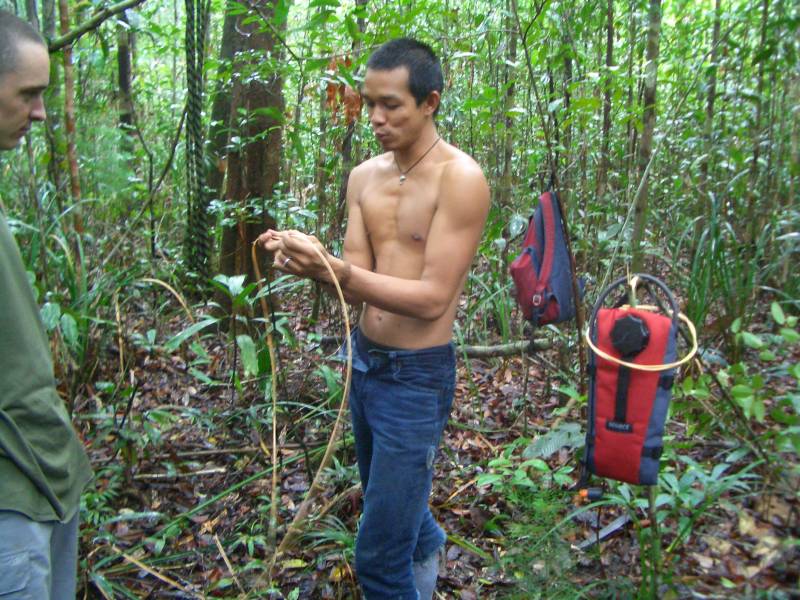 their way to the first tree on which they would feed during the day. We followed on the forest floor below, negotiating fallen trees and sometimes thickly wooded forest. She would spend between 5 minutes and 2 hours in any given tree depending on the amount of fruit available and presumably how it tasted.
Orangutans eat a wide variety of fruits, leaves, bark, chutes and even ants (over 300 different different food sources have been recorded). All this information plus the locations of trees within the forest, when they fruit and how to eat the fruit is passed from mother to daughter/son which is partly why the infant stays permanently for such a long period (7-8 years) with its mother.
 That afternoon, Michelle slipped out of view for a few seconds. We stopped and looked up into the canopy looking for a dark orange body or for swaying branches, but we saw nothing. She had sneaked away. We split up and circled the area but had no luck. Sebri and Herman were devastated - they try to track an orangutan for as long as possible (more than 30 days of continuous research have often been recorded) so to lose her on just the second day was deflating.
It was about 3pm so time was short (dusk is at about 6pm and Michelle had nested at 5.15pm the previous day). We decided to continue searching intently all working hard, looking and listening. It paid off - just over an hour later we found Michelle again high up in a ancient fruit tree. We were all highly relieved and determined not to lose her again.
The two of them moved slowly through the forest, mother leading, daughter following (occasionally kiss-squeaking and throwing branches and fruit stones at us) until she built her nest at about 5.45pm.
About 10 hours of new research notes had been made by the guys which would be typed up, archived and sent to the Professor (currently working at UCLA) adding to over 100,000 hours collected over the last 33 years. We had a brisk hour walk back to camp, pausing only at 6.30pm for the guys to break their Ramadan fast (some Dayak's have adopted Islam, the predominant religion of Indonesia). It was a day to remember.
See for yourself
So, these were a few highlights of my trip. It was an unforgettable 6 weeks and I highly recommend the Volunteer Program for an adventure holiday to anybody interested in primates, conservation and/or forests. If you are not entitled to 6 weeks off work, I suggest you quit your job or go for the 3 week option!
Here are some other links you might like to check out (they open in new windows):
- Orangutan Foundation website
- The range of treks operated by the Orangutan Foundation
- Fill in this petition supporting action against illegal logging
- Buying someone a present? Get something meaningful from Good Gifts.
- Organistation promoting the sustainable palm oil plantation.
- Learn about the Sustainable Forestry Initiative.
More photos, movies and sounds
 Unyuk waking down the jetty (5.1 MB)
- Destruction caused by the goldmine (4.4 MB)
- Tom moving through the forest (11.2 MB)
- Siswi plays in hammock (19.6 MB)
- Uranus munches dry noodles (10.1 MB)
 Frogs by Camp Leakey jetty at 1946hrs (6.0 MB)
- Frogs and insects by jetty at 1925hrs (3.4 MB)
Just a few more photos...
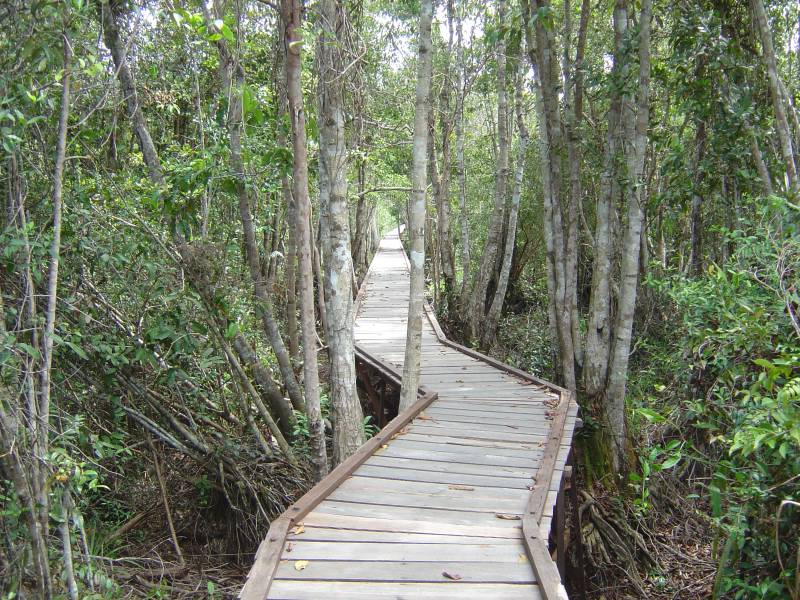 The new jetty, built by previous volunteers |
 Standing around the toilet hole after we sealed it for the next 82 years use |
 Photovoltaic solar panels that provide electricity to camp |
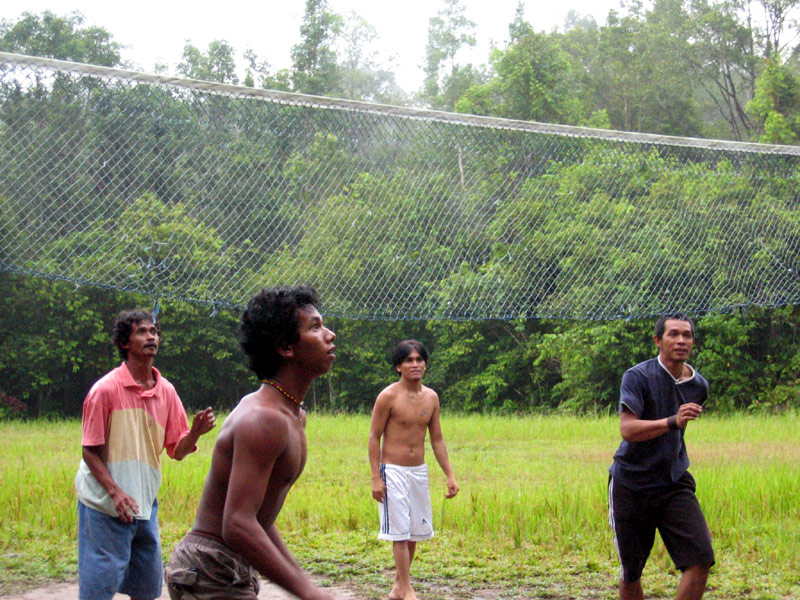 The guys play basketball after a hard days work |
 Taking a break from the midday sun |
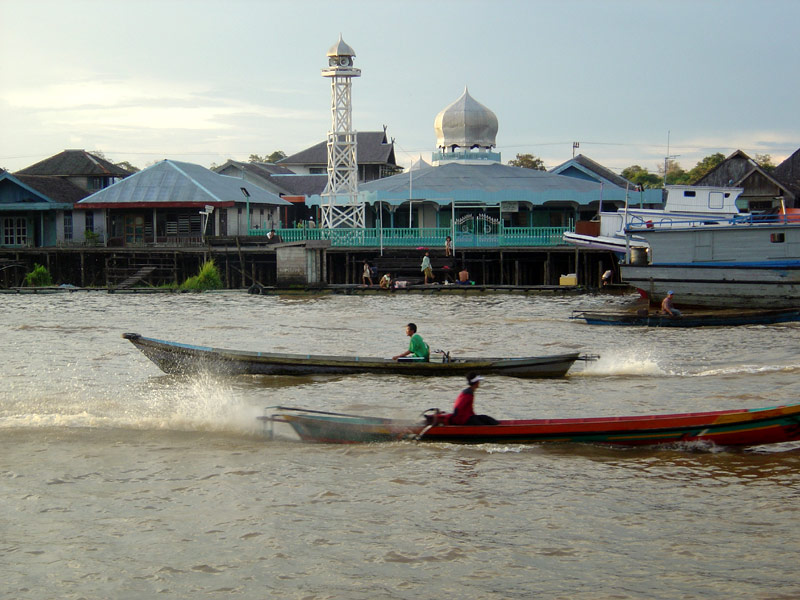 Klotoks speeding down the river at Pangkalan Bun, Mosque in background |
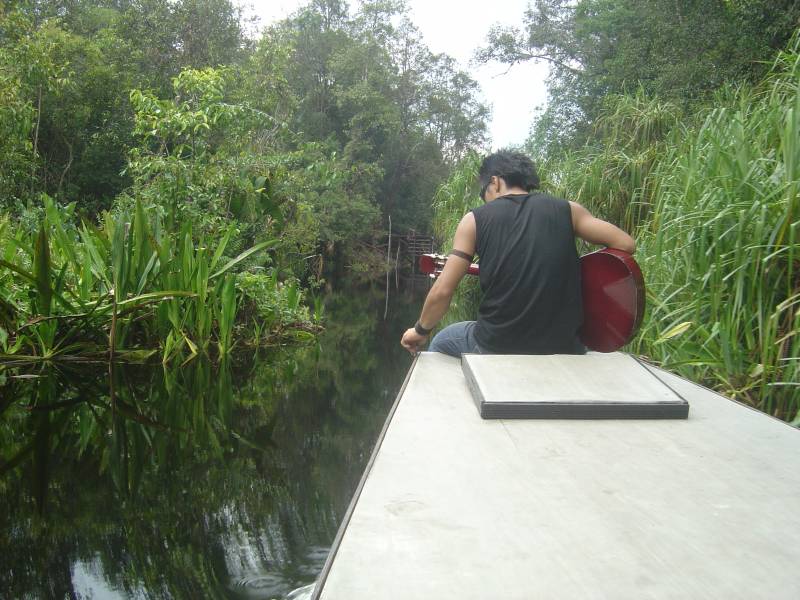 John strums as we work our way down the river |
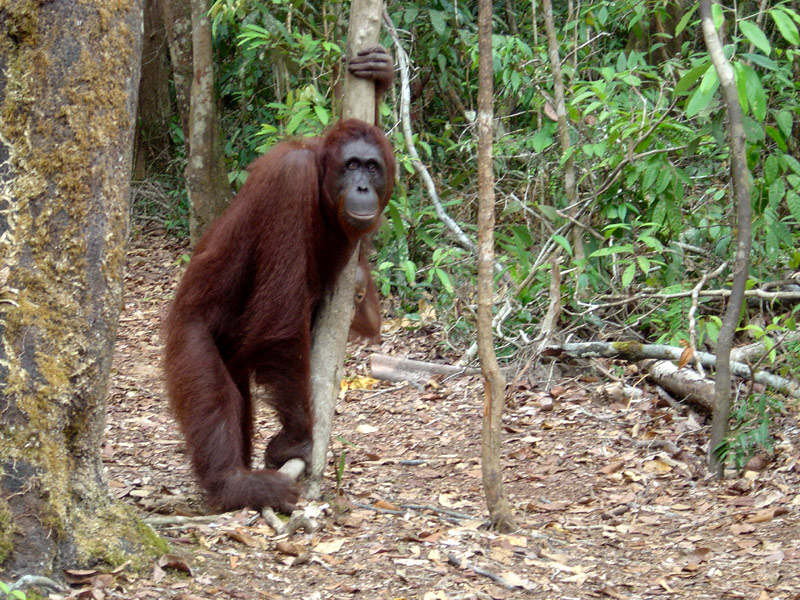 Princess walking to the feeding station |
 The original jetty at Camp Leakey, built in 1975 |
 Roy paints the welcome sign |
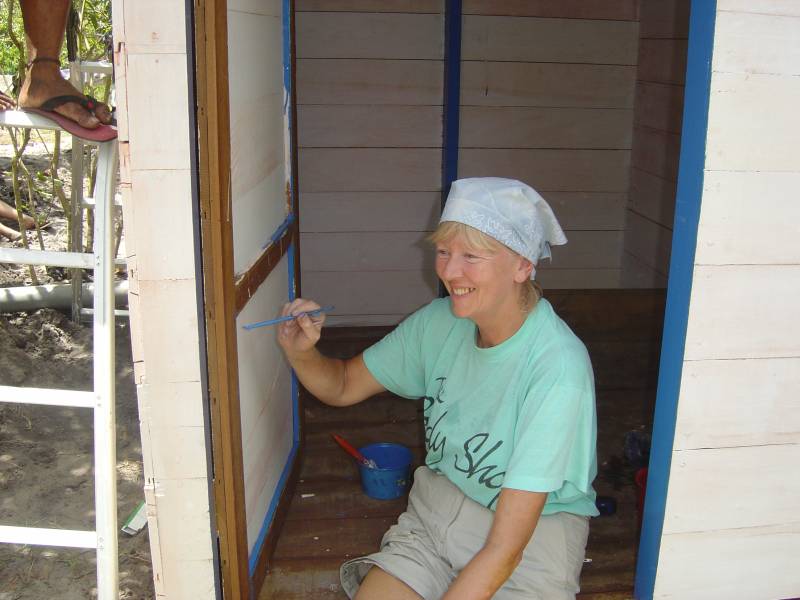 Cynthia paints the sign on the toilet door |
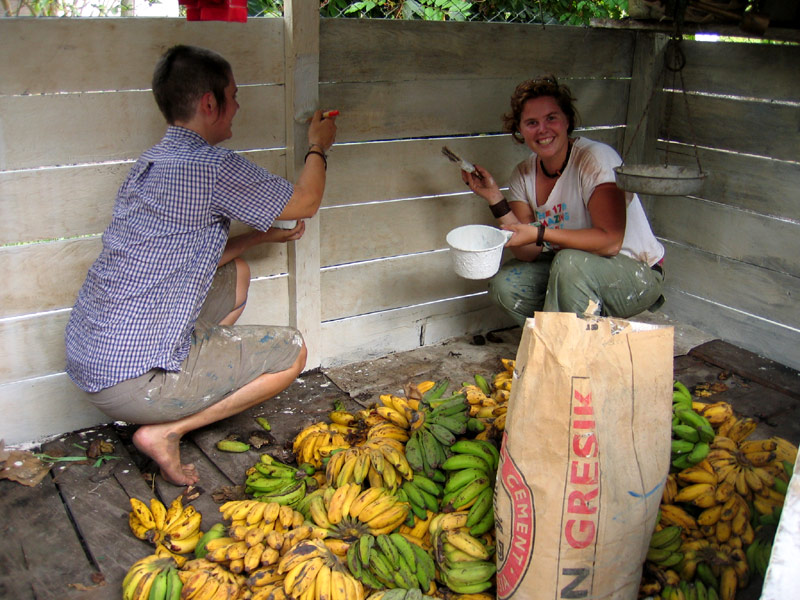 Barbara and Pip paint the feeding storeroom |
 Adult male Win holds up hands to shelter from rain |
 Klotok by the jetty where we used to mandi (wash) |
 Rob with the local family we stayed with one night |
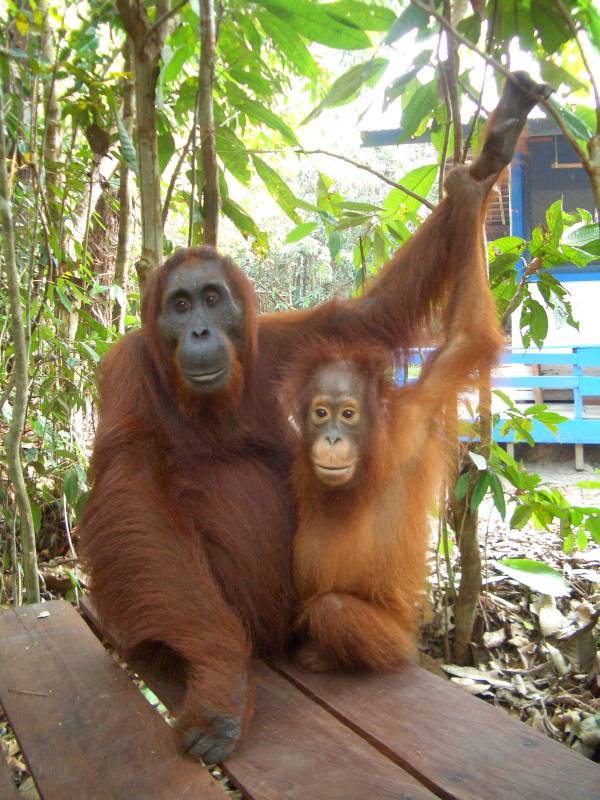 Tutuk sits with her son Thomas |
 Tom hangs on to his bananas |
 Siswi uses box to shelter from rain as she eats a root |
 The Information Centre (built by volunteers) |
 Siswi and Sampson wash with us. They learn through mimic. |
 Siswi and Samson (mother and son) grooming |
 Tom swings through the trees |
 Team 4 volunteers on a klotok |
 Thomas playing on jetty |
 Siswi plays in a hammock |
 Uranus munches on some dry noodles he helped himself to |
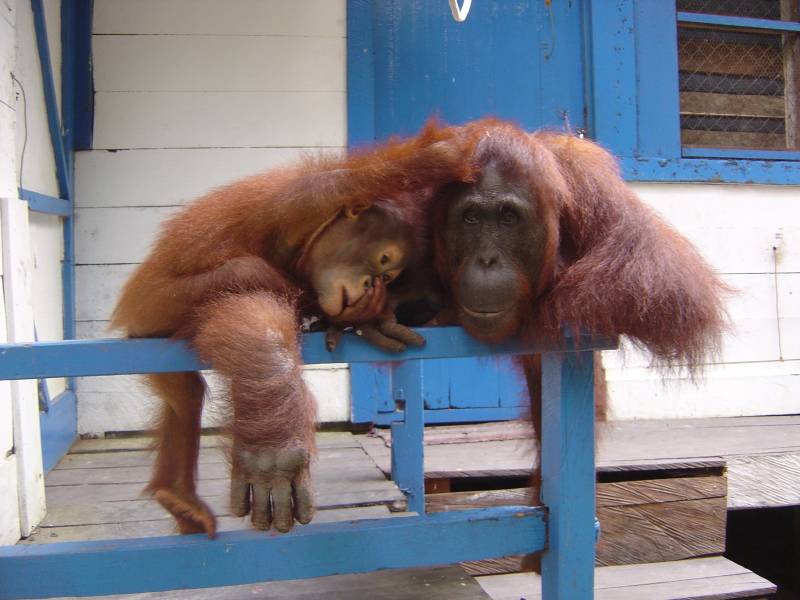 Unyuk and Untung by the team house door |
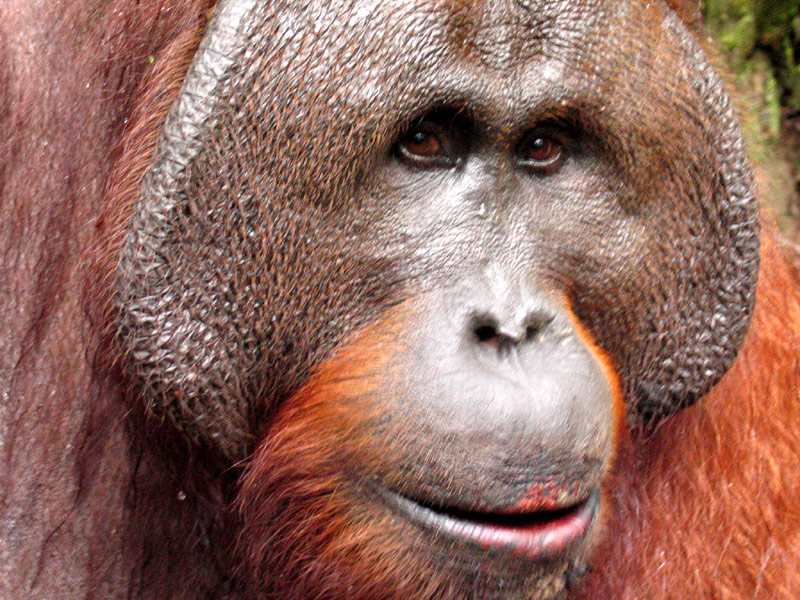 Close up of Uranus |
 These gibbons were also rehabilitated by the Foundation |
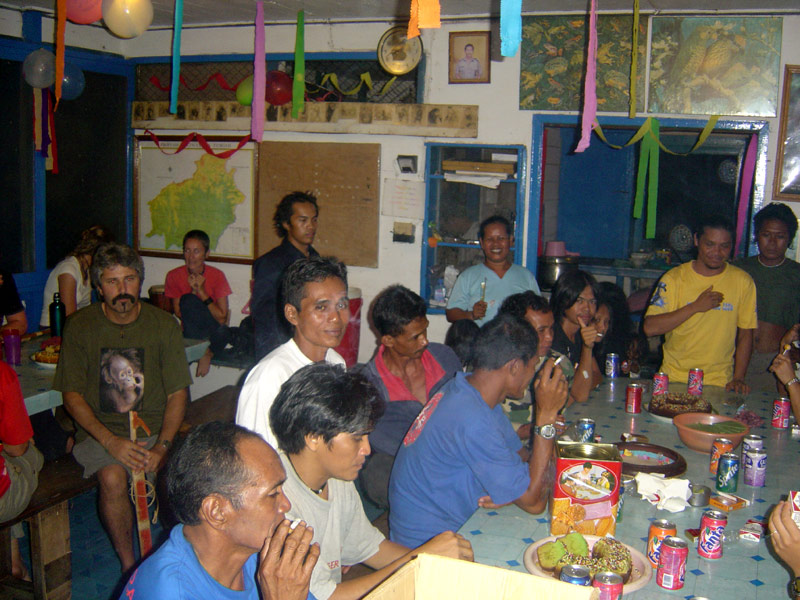 Party at camp on our last night, with lots of chicken! |
Published by Jake Brumby on 31st December 2004